












Quick Answer
RFID improves cross-border logistics efficiency by enabling automatic cargo identification, reducing manual scanning, accelerating warehouse throughput, increasing inventory accuracy above 99%, shortening handling time by up to 70%, and providing real-time visibility across ports, warehouses, and international transport nodes. It replaces fragmented barcode-based workflows with continuous, multi-node tracking across the global supply chain.
Speed
Cross-border logistics is no longer defined by transportation speed alone, but by how efficiently cargo passes through multiple operational nodes without delay. In global trade networks involving customs clearance, bonded warehouses, port terminals, air cargo hubs, and overseas distribution centers, even small inefficiencies compound into significant lead-time losses.
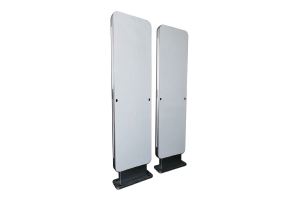
Traditional barcode systems rely heavily on manual scanning. In high-volume environments, a single operator typically processes only a few hundred units per hour. In contrast, RFID portals can read hundreds of tagged items within seconds without line-of-sight, fundamentally changing throughput capacity. Across modern distribution centers, inbound processing time has been reduced by more than 70%, while inventory accuracy has improved from 85–92% in manual systems to over 99% in RFID-enabled environments.
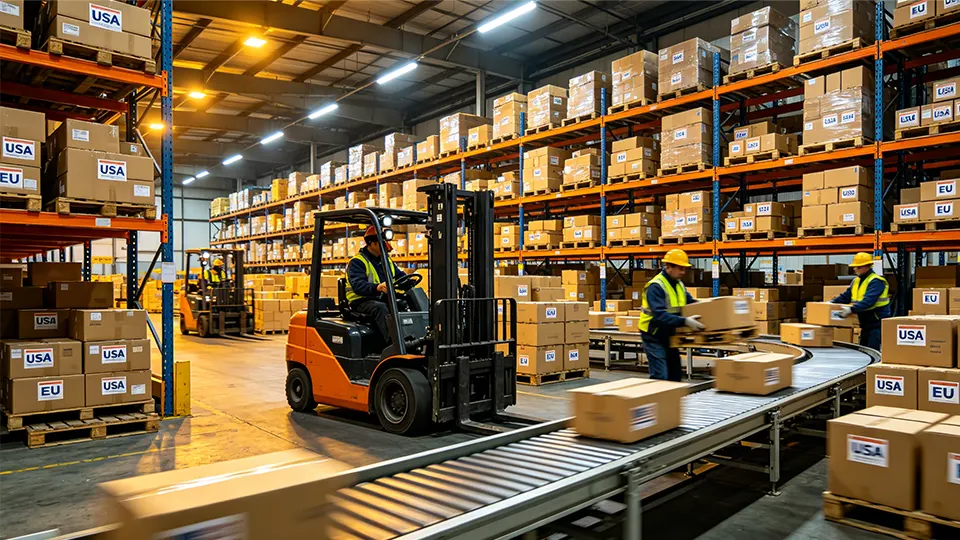
The efficiency gain is driven by UHF RFID standards such as EPC Gen2 and ISO 18000-6C, which allow simultaneous multi-tag reading in dense environments. At cross-border consolidation hubs, this enables automatic cargo capture during movement through dock doors, eliminating repeated scanning steps. As a result, receiving operations that previously required two hours can often be completed in under twenty minutes, while sorting throughput can increase by 3 to 10 times depending on cargo density.
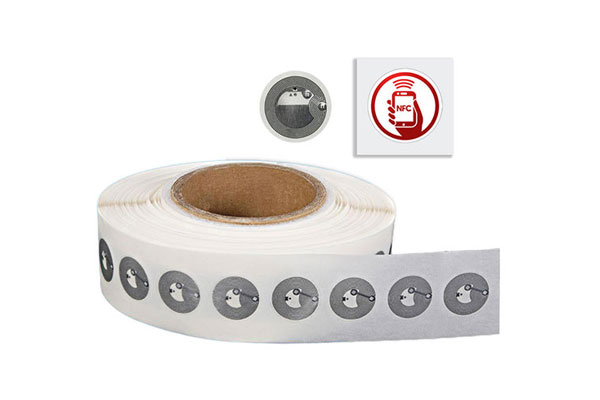
Chip performance is a key enabler of this improvement. Widely deployed RFID chips include Impinj M730/M830, Impinj Monza 4QT, NXP UCODE 9, and UCODE 9xe. These chips are optimized for high-density anti-collision environments, enabling stable performance even when thousands of tagged items are read simultaneously. For example, UCODE 9 is widely used in logistics due to its high sensitivity and reliability in complex RF environments.
RFID removes the need for cargo to stop for identification. Instead, identification happens in motion, which fundamentally changes the rhythm of logistics flow.

Flow
In cross-border logistics, inefficiency is often not caused by transportation delays, but by micro-stoppages at transfer points. Cargo waiting in staging areas, containers queued at gates, and shipments paused during transshipment all contribute to cumulative delays that significantly extend delivery cycles.
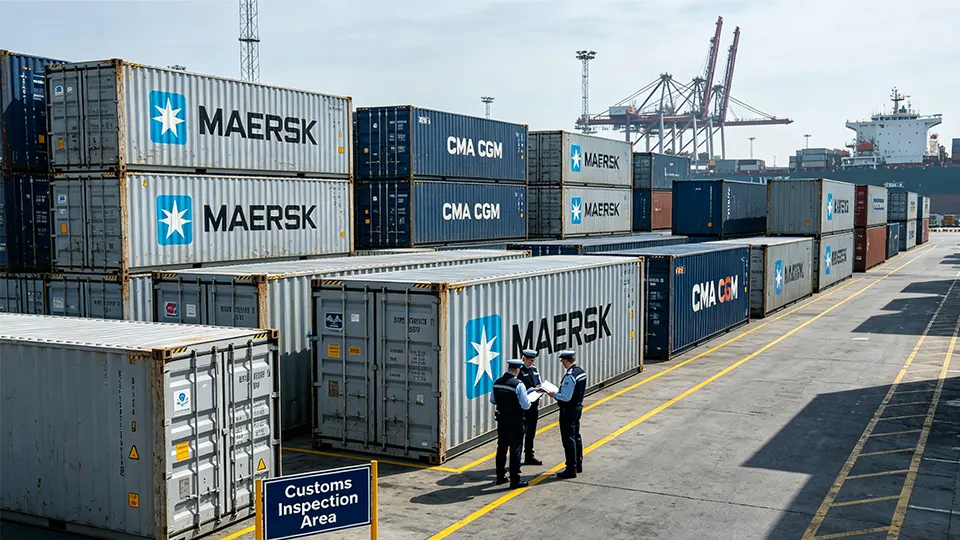
RFID improves flow continuity by enabling real-time identification at every transition point. At port entry gates and inland terminals, RFID-enabled systems can automatically recognize containers and vehicles as they approach, reducing gate processing time by 30% to 60% and significantly decreasing congestion.
Inside sorting centers, RFID supports automated routing decisions. Conveyor systems can dynamically direct parcels based on real-time tag reads, reducing mis-sorting rates by more than 90% while increasing peak-hour throughput without proportional labor growth.
Cargo flow becomes more efficient when RFID is applied across multiple packaging levels. Item-level, carton-level, pallet-level, and container-level tagging create a hierarchical tracking structure. This enables what logistics operators refer to as nested visibility, where a single pallet can be tracked while still preserving the identity of each individual shipment inside it.
Operational improvements commonly include:
- Faster inbound and outbound verification cycles
- Reduced dwell time at transfer nodes
- Higher sorting throughput with fewer routing errors
- Improved utilization of reusable transport assets
These improvements position RFID not merely as an identification tool, but as a core flow-control infrastructure within modern logistics networks.
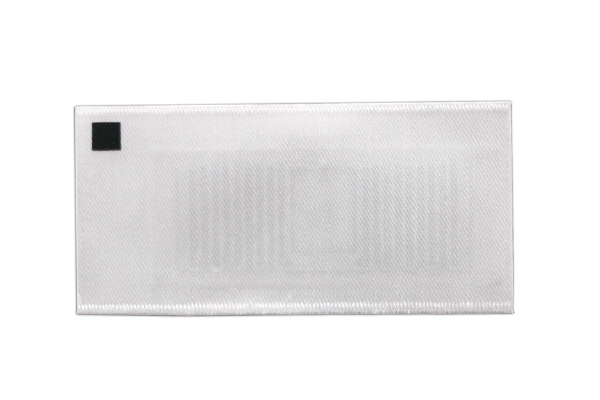
For industrial-scale deployments, RFID labels based on Impinj M730 and Impinj M830 are widely used. In returnable asset tracking scenarios, industrial-grade solutions such as dtbrfid.com’s DTB-F7030 UHF Anti-Metal Tag are deployed for metallic containers and logistics equipment. These tags often support up to 100,000 write cycles and multi-year lifecycle usage in cross-border circulation environments.
Visibility
Cross-border logistics depends heavily on visibility, as cargo frequently moves across multiple independent systems operated by freight forwarders, customs authorities, carriers, and warehouse providers. Without unified tracking, delays and exceptions are difficult to detect in real time.
RFID enables continuous event capture across the logistics network. Each scanning point—warehouse doors, staging lanes, customs checkpoints, port exits, and overseas hubs—becomes a digital visibility node. Unlike barcode systems that require manual scanning, RFID automatically generates movement events as cargo passes through each node.
This enables real-time exception detection. For example, a pallet delayed at a bonded warehouse can be identified before it impacts downstream delivery. A container routed incorrectly can be flagged prior to departure. Cargo dwelling beyond expected thresholds can be detected early, reducing disruption risk.
In operational deployments, RFID systems have delivered measurable improvements:
Inventory accuracy exceeding 99% after implementation
Cycle counting time reduced by 80% to 95%
Exception handling time reduced by more than 50%
These metrics directly improve cargo turnover speed and reduce operational uncertainty.
RFID also enhances predictive logistics capabilities. When read-event data is aggregated across thousands of shipments, patterns become visible. Bottlenecks at specific transfer nodes can be quantified, dwell time averages can be measured, and routing inefficiencies can be identified with precision.
Visibility is no longer just monitoring—it becomes a direct driver of operational efficiency.
Warehouses
Warehouse operations are a critical determinant of cross-border logistics efficiency. Even when transportation networks are optimized, inefficiencies inside warehouses can significantly delay order fulfillment and inventory turnover.
RFID improves warehouse performance across multiple operational stages. Incoming goods can be automatically captured during movement, eliminating manual scanning. Storage locations can be tracked in real time, improving put-away efficiency. Inventory counting shifts from labor-intensive cycles to near real-time visibility.
In RFID-enabled environments, full warehouse inventory counts that previously required up to eight hours or overnight shutdowns can often be completed in approximately thirty minutes. Some operations report counting speed improvements between 10 and 30 times compared with traditional barcode systems.
This has a direct impact on cross-border e-commerce operations, where fast inventory turnover is essential. Reduced inventory uncertainty allows companies to lower safety stock levels while maintaining service reliability.
Common improvements include:
- Inventory turnover increase driven by higher accuracy
- Labor cost reduction due to reduced manual operations
- Faster order fulfillment cycles
- Reusable asset circulation rate increases exceeding 30%
Cold chain logistics also benefits significantly. RFID enables continuous tracking of pharmaceuticals, perishable goods, and high-value controlled shipments, ensuring both identity and compliance traceability across international borders.
Warehouse operations shift from manual control systems to automated logistics acceleration systems.
Networks
The most significant efficiency gains from RFID occur when it evolves from a localized warehouse tool into a network-level logistics infrastructure.
In cross-border logistics ecosystems, cargo moves across ports, warehouses, air cargo terminals, and overseas distribution centers under fragmented system ownership. RFID provides a unified physical data layer that connects these systems.
At this level, logistics operations shift from manual coordination to automated network orchestration. Cargo movement becomes continuously traceable across multiple independent operators.
In container and asset-heavy logistics systems, RFID improves utilization of pallets, cages, totes, and containers by 20% to 30% or more, reducing both shortages and idle asset time. This directly improves operational efficiency and reduces capital waste.
In customs and compliance processes, RFID improves document matching accuracy by ensuring that physical cargo identity is consistently aligned with digital records, reducing clearance delays and operational friction.
The broader industry shift positions RFID not as a warehouse technology, but as a foundational layer of supply chain execution systems.
FAQ
What is RFID in cross-border logistics?
RFID is a wireless identification technology that enables automatic tracking of cargo across international supply chain nodes without manual scanning.
How does RFID improve cargo flow efficiency?
RFID improves cargo flow by reducing handling time, enabling real-time tracking, increasing sorting speed, and eliminating manual identification delays.
What RFID chips are commonly used in logistics?
Common chips include Impinj M730/M830, Impinj Monza 4QT, NXP UCODE 9, and UCODE 9xe.
Can RFID reduce customs delays?
Yes. RFID improves cargo traceability and documentation accuracy, which can reduce inspection and clearance delays.
Final Insight
RFID has evolved from a tracking tool into a logistics infrastructure layer. Its impact is no longer limited to faster scanning, but extends to system-wide optimization of cargo flow, visibility, and network coordination. In modern cross-border logistics, efficiency is increasingly defined by data continuity—and RFID is one of the key technologies enabling that continuity.

