











In asset-intensive industries, loss rarely looks dramatic. There is no obvious theft, no broken lock, no clear moment when something goes wrong. Instead, items simply stop showing up where they are expected to be.
This is especially true for high-frequency turnover items — tools, containers, fixtures, kits, and reusable assets that move dozens of times per day across production lines, hospitals, warehouses, and service environments. Each individual item may be inexpensive, but at scale, disappearance becomes a systemic cost driver.
RFID, when designed specifically for anti-loss rather than inventory counting, offers a fundamentally different way to manage this problem.
1. Why High-Frequency Turnover Items Are Uniquely Vulnerable to Loss
High-frequency turnover items share several characteristics that make them difficult to control using traditional methods.
They move quickly, often passing through multiple hands, zones, or processes within a single shift. Responsibility is distributed rather than centralized. Most importantly, loss is rarely intentional. Items are misplaced, forgotten, temporarily parked, or diverted into unofficial workflows.
Common examples include:
- Manufacturing fixtures, jigs, and toolkits
- Logistics totes, cages, and foldable containers
- Medical instrument trays and transport carts
- Maintenance tools and inspection equipment
In these environments, loss is not a binary event. It is a progressive breakdown of visibility. By the time an item is officially considered “missing,” the opportunity for easy recovery is already gone.
2. Why Traditional Anti-Loss Methods Fail at Scale
Manual controls break down when turnover speed increases.
Paper logs and spreadsheets depend entirely on human compliance. Barcode systems require deliberate scanning actions that slow work and are frequently bypassed under pressure. Video surveillance can show where an item was last seen, but rarely provides structured data that can be acted on in real time.
The fundamental limitation is that these systems capture events, not states. They record that something happened, but they do not continuously describe where an item is in its operational lifecycle.
High-frequency environments need systems that work with the flow of work, not against it.
3. RFID as a State-Awareness System, Not Just an Identification Tool
The real value of RFID in anti-loss applications lies in its ability to capture state transitions automatically.
Instead of asking whether an item exists, RFID allows systems to answer more useful questions:
- Where should this item be right now?
- How long has it been in its current state?
- Has it deviated from its expected path?
- Is this delay normal, or is it an early indicator of loss?
Because RFID does not require line-of-sight or manual triggering, it can operate continuously in the background. This makes it uniquely suitable for environments where speed, repetition, and volume make manual tracking unrealistic.
4. Core RFID Anti-Loss Strategy Patterns
Effective RFID anti-loss systems are rarely built around a single mechanism. Instead, they combine several complementary patterns.
4.1 Controlled Entry and Exit Monitoring
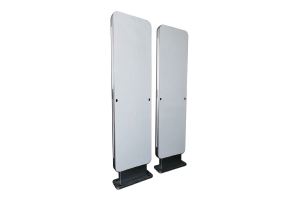
Portal-based RFID monitoring at key entry and exit points remains one of the most effective baseline controls.
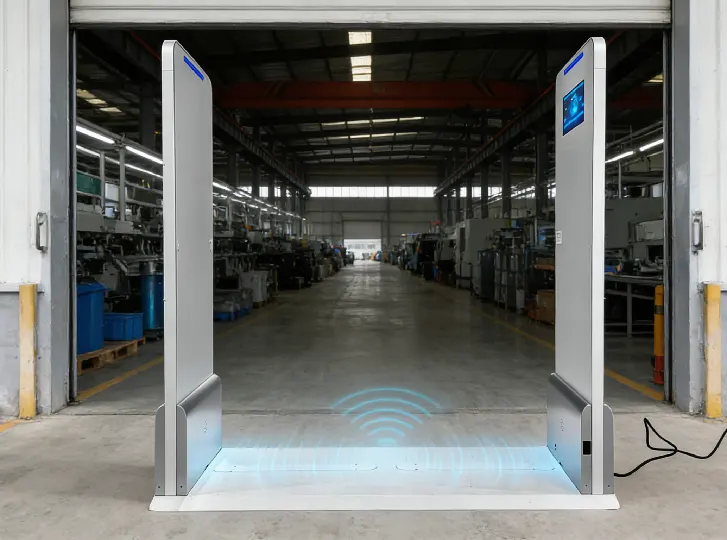
By installing RFID readers and antennas at doors, corridors, or process boundaries, organizations can automatically capture when tagged items move in or out of controlled areas. Directional logic allows systems to distinguish between inbound and outbound movement.
This pattern is especially effective for preventing “unconscious loss” — items leaving a space simply because no one noticed they were being carried out.
4.2 Intermediate Zone Visibility
Most losses do not occur at final exits. They happen between steps.
Deploying RFID read zones at intermediate locations — tool cribs, staging areas, sterilization rooms, or maintenance bays — allows systems to track how items move between operational states rather than just between rooms.
This creates a continuous chain of custody without forcing workers to perform explicit check-in or check-out actions.
4.3 Dwell-Time-Based Loss Prevention
One of the most powerful anti-loss techniques is time-based anomaly detection.
Every high-frequency item has a statistically normal dwell time in each process step. When an item remains in one location significantly longer than expected, it becomes a candidate for investigation long before it is officially “lost.”
This approach shifts loss prevention from reactive investigation to proactive intervention.
4.4 Quantity Reconciliation and Exception Detection
RFID also enables automated reconciliation of expected versus actual item counts.
When items enter or leave a zone in batches, the system can continuously compare observed quantities against planned quantities. Discrepancies are flagged immediately, not at the end of a shift or inventory cycle.
This is particularly effective in logistics and distribution environments where manual counting is both slow and error-prone.
5. RFID Chip Selection for High-Frequency Anti-Loss Systems
Chip selection plays a decisive role in system reliability. Anti-loss systems depend on consistent reads over long periods, often in challenging environments.
5.1 High-Frequency (HF) Chip Options
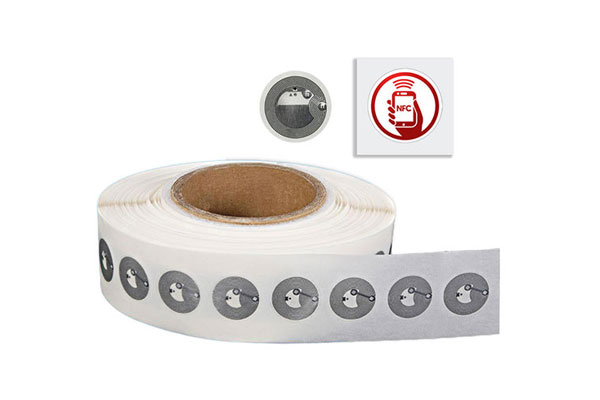
HF RFID operates at 13.56 MHz and is well suited for close-range, dense-tag environments where controlled read zones are required.
Widely used HF chip families include:
- NXP ICODE SLIX series, commonly used in industrial asset tracking due to strong anti-collision performance and stable reads in multi-tag environments.
- NTAG 213 and NTAG 216, often selected when NFC compatibility is useful for maintenance or verification tasks using mobile devices.
- MIFARE DESFire, chosen in cases where higher memory capacity or secure authentication is required for asset history or authorization data.
HF systems are particularly effective in tool management, healthcare workflows, and controlled production environments.

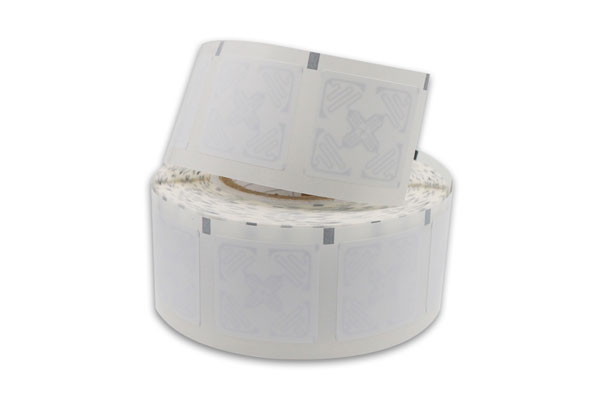
5.2 Ultra-High Frequency (UHF) Chip Options
UHF RFID is preferred when longer read ranges and high-speed batch detection are required.
Common UHF chip families include:
- Impinj Monza series, known for high sensitivity and consistent performance in logistics and industrial tracking scenarios.
- NXP UCODE series, offering flexible memory configurations and good performance across varied materials.
- Alien Higgs series, often used where cost efficiency and reliable bulk reading are priorities.
UHF is typically deployed in portals, conveyors, and vehicle-based asset movement scenarios.
5.3 Special-Purpose and High-Memory Chips
Some anti-loss applications require more than identification. High-memory HF chips with FRAM or EEPROM storage can retain process history, usage counters, or condition flags directly on the tag.
These solutions are used selectively, but they can add resilience when network connectivity or system availability is not guaranteed.
6. Tag Design, Mounting, and Environmental Adaptation
Even the best chip will underperform if tag design is ignored.
High-frequency turnover items are often exposed to:
- Repeated handling
- Mechanical stress
- Cleaning or sterilization processes
- Metal surfaces or liquid proximity
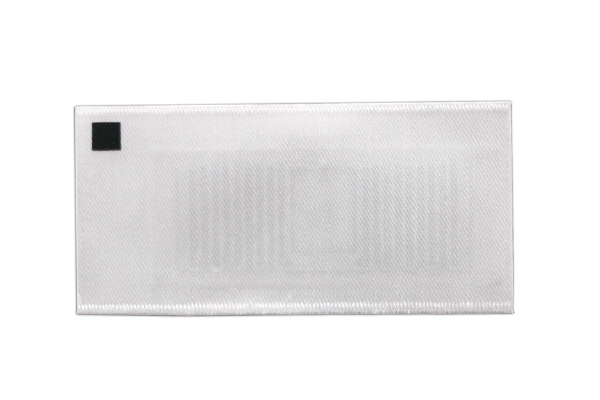
Anti-loss deployments typically use ruggedized tag housings, fixed mounting points, and material-specific antenna designs. On-metal tags and encapsulated labels are common where durability and read consistency matter more than unit cost.
7. Reader Placement and RF Engineering
RFID anti-loss systems are engineered, not merely installed.
Reader power levels, antenna orientation, and read-zone boundaries must be tuned to avoid blind spots, over-reads, and false positives. Site surveys and iterative testing are essential, particularly in metal-dense or high-interference environments.
Poor RF design leads to unreliable data, which undermines trust in the system and ultimately defeats the purpose of anti-loss monitoring.
8. Reducing False Alerts Through Contextual Logic
An effective anti-loss system is not the one that generates the most alerts, but the one that generates the right alerts.
Advanced deployments filter raw RFID events through contextual logic:
- Time-based thresholds
- Process-state validation
- Cross-zone correlation
By focusing on patterns rather than single reads, systems avoid alert fatigue and ensure that operational teams respond when it actually matters.
9. Business Impact Beyond Loss Reduction
Organizations that deploy RFID anti-loss systems consistently report benefits beyond reduced disappearance rates.
Typical outcomes include:
- Higher asset utilization
- Reduced buffer stock and over-purchasing
- Faster process cycles
- Lower labor costs associated with searching and reconciliation
- Improved audit readiness and compliance
Loss prevention becomes a side effect of improved operational visibility rather than the sole objective.

10. From Prevention to Predictive Control
As RFID data accumulates over time, anti-loss systems evolve into predictive tools.
Patterns emerge. Bottlenecks become visible. Processes that consistently produce delays or anomalies can be redesigned. In mature deployments, RFID becomes part of a broader operational intelligence layer rather than a standalone tracking system.
One example is the deployment of a DTB RFID UHF fixed reader as part of a multi-zone monitoring architecture, where hardware reliability enables long-term behavioral analysis rather than short-term event logging.
11. Engineering Anti-Loss as a System Capability
High-frequency turnover loss is not a personnel issue, nor is it a discipline problem. It is a systems problem.
RFID offers the tools to solve it — but only when deployed as part of a thoughtfully engineered strategy that aligns technology, workflow, and data interpretation.
When anti-loss becomes embedded into everyday operations, items stop “disappearing.” They become visible, accountable, and predictable — exactly what high-velocity environments require.

