








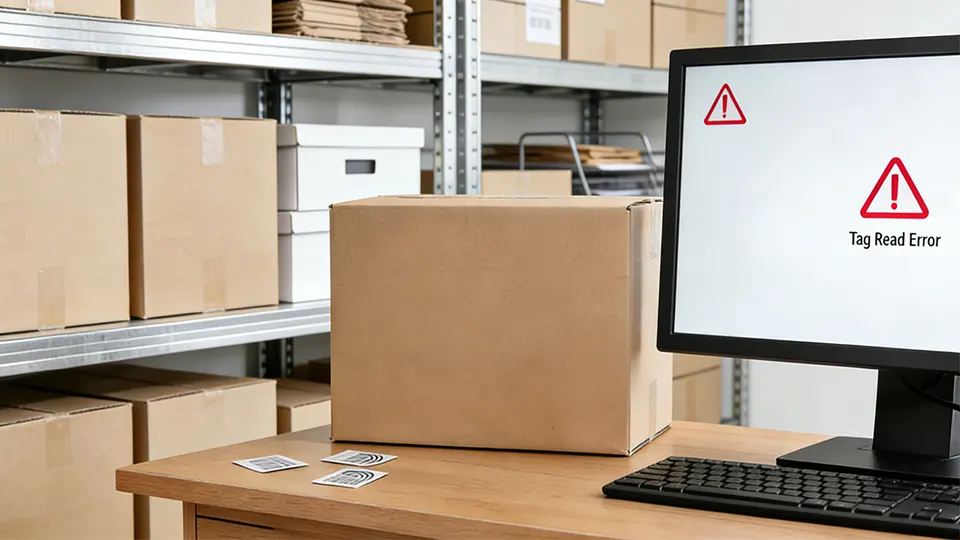
RFID projects rarely collapse because the technology “doesn’t work.” They collapse because the system was never engineered as a system.
Across warehouse logistics, hospital asset tracking, apparel distribution, industrial tool control, and government archives, organizations report similar frustrations:
- “RFID read accuracy dropped after deployment.”
- “Inventory fluctuates even when nothing moves.”
- “The ERP data doesn’t match physical stock.”
- “The pilot worked. Full rollout didn’t.”
These are not isolated technical failures. They are architecture failures, workflow misalignments, and RF planning mistakes.
This guide analyzes common RFID system problems and provides practical, engineering-level solutions based on real deployment patterns. It goes beyond superficial troubleshooting and addresses structural causes that determine long-term stability.
RFID Read Issues: Why Real Environments Break Lab Expectations
Unstable Read Distance in UHF Deployments
One of the most searched long-tail queries is:
“Why is my RFID read range shorter than expected?”
In lab tests, UHF tags built on chips from Impinj often achieve 6–8 meters under ideal free-space conditions. However, in production warehouses with metal shelving, forklifts, and high humidity, stable read range may shrink to 2–3 meters.
The difference is not random.
Core Causes
Multipath interference
Polarization mismatch
RF shadowing
Power reflection from metallic racks
Reader power misconfiguration
Increasing power from 27 dBm to 30 dBm rarely solves the issue. In fact, higher power often increases noise and ghost reads.
Engineering Solution
Design around minimum stable read distance, not maximum theoretical range.
Conduct RF site surveys using spectrum analysis tools.
Match antenna polarization (linear vs circular) to tag orientation.
Use multiple lower-power antennas instead of one high-power antenna.
RF performance is environmental physics, not marketing specification.
Missed Reads in Dense Tag Environments
In carton-level logistics or apparel distribution, dense tag clusters cause intermittent missed reads.
Even though EPC Gen2 anti-collision protocols are designed for this, improper configuration undermines performance.
Typical Configuration Errors
Static Q-value instead of dynamic Q adjustment
Incorrect session selection (Session 0 vs Session 1)
Insufficient dwell time in gate tunnels
Inventory round cycles too short
Many integrators never optimize Q algorithm behavior.
Practical Optimization Strategy
Enable dynamic Q algorithms.
Increase dwell time in conveyor tunnels.
Perform multi-pass validation before confirming transactions.
Separate signal-level reads from business-level events.
RFID is probabilistic. Treating it as binary guarantees disappointment.
Metal and Liquid Interference
Another frequent search query:
“Why doesn’t RFID work on metal?”
Metal reflects RF signals. Liquids absorb them. This is fundamental electromagnetic behavior.
HF (13.56 MHz) tags using chips from NXP Semiconductors such as NTAG series perform reliably for document tracking but degrade when mounted directly onto conductive surfaces without isolation layers.
UHF labels applied to liquid-filled containers suffer from signal attenuation unless spacing materials are introduced.

Practical Solutions
- Use on-metal tags with foam isolators.
- Maintain 3–5 mm minimum spacing from conductive surfaces.
- Test both HF and UHF before finalizing architecture.
- Avoid “one frequency fits all” decisions.
Choosing frequency band strategically often improves stability more than upgrading hardware.
RFID Middleware and EPC Event Processing Problems
Many RFID troubleshooting guides focus only on hardware. In reality, data architecture failures cause most long-term instability.
Raw EPC Events Overload the System
A single fixed reader at a dock door may generate 5,000+ EPC reads per minute. Writing every event directly into inventory tables causes:
- Inventory oscillation
- Duplicate entries
- ERP sync failures
- Database performance degradation
RFID generates signal events, not confirmed transactions.
Recommended Architecture
- Deploy edge-level filtering near the reader.
- Use event aggregation windows (e.g., 500ms–2s).
- Convert multiple reads into one validated movement event.
- Store raw EPC logs separately from transactional data.
Without middleware intelligence, read accuracy metrics become meaningless.
No State Machine for Asset Lifecycle
In asset tracking deployments (hospital equipment, IT devices, industrial tools), items transition through states:
- In storage
- Checked out
- Under maintenance
- In transit
- Reserved
- Retired
If backend logic only tracks “detected” or “not detected,” the system cannot interpret operational meaning.
Structural Solution
Implement a state machine model:
- Define allowed state transitions.
- Prevent invalid transitions.
- Attach timestamp validation rules.
- Record transition origin zones.
State logic transforms RFID visibility into operational control.
Industry-Specific RFID Failure Scenarios
Warehouse RFID Deployment Problems
Common search phrase:
“Warehouse RFID system accuracy problems.”
In a 50,000 sq ft warehouse with pallet-level tagging:
Observed issues after rollout:
- 92% read accuracy at dock doors (target was 98%)
- Inventory mismatch between WMS and physical stock
- Cross-dock misreads due to adjacent gates
Root causes:
- Overlapping antenna fields
- Improper channel allocation
- No directional logic
Corrective Measures
- Reduce power from 30 dBm to 26 dBm to shrink read zone.
- Implement direction detection using multi-antenna timing difference.
- Assign non-overlapping frequency channels.
- Introduce confirmation scans before ERP posting.
After reconfiguration, accuracy improved to 98.6%.
This was not a hardware change. It was architectural refinement.
Hospital High-Turnover Asset Tracking
In healthcare environments, mobile equipment such as infusion pumps and wheelchairs frequently move between departments.

Common issues:
- “Missing” assets that were actually in adjacent rooms.
- Staff ignoring alerts due to false positives.
- Tag damage during sterilization cycles.
Key lesson:
RFID must align with workflow patterns.
Improvements
- Combine RFID with room-level zoning.
- Use ruggedized tags rated for high-temperature exposure.
- Implement dwell-time logic before marking assets as relocated.
High-turnover environments require intelligent filtering, not aggressive scanning.
Apparel Distribution and Shrinkage Control
In apparel distribution centers:
- Carton-level tagging may work.
- Item-level tagging introduces density complexity.
Common mistake:
Deploying tunnel readers without density simulation testing.
Improvement method:
- Simulate peak density (150–300 items per carton).
- Extend conveyor dwell time.
- Separate inbound and outbound antenna arrays.
Shrinkage reduction depends more on controlled read zones than raw read range.
RF Interference and Environmental Engineering
Multipath and Null Zones
In industrial environments with heavy machinery, RF waves bounce unpredictably.
Symptoms:
- Random ghost reads.
- Dead spots near metal pillars.
- Inconsistent read reliability.
Engineering Fix
- Adjust antenna tilt incrementally (5–10 degrees).
- Lower transmit power instead of raising it.
- Introduce RF absorbing panels.
- Use more antennas at lower power.
High power increases reflection chaos.
Reader-to-Reader Interference
Large facilities often deploy multiple readers operating simultaneously.
If frequency channels overlap:
- Performance degrades.
- Missed reads increase.
- System logs appear inconsistent.
Mitigation
- Configure channel hopping correctly.
- Assign static channels where necessary.
- Physically separate antennas.
- Monitor RF spectrum periodically.
RF planning must scale with deployment size.
ERP Integration and Scalability Risks
ERP Synchronization Failures
When ERP posting is triggered immediately by raw read events, transaction inconsistencies appear.
Best practice:
- Use asynchronous messaging queues.
- Implement retry logic.
- Log reconciliation events.
- Schedule periodic stock validation cycles.
Speed is less important than data integrity.
System Scalability Planning
Many RFID projects start small but expand quickly.
Without planning for 3x tag volume:
- Database latency increases.
- Middleware crashes.
- Network congestion appears.
Scalable architecture includes:
- Microservice separation between RF processing and business logic.
- Independent event logging system.
- Stress testing before expansion.
RFID Troubleshooting Checklist for Deployment Teams
To reduce risk in real-world RFID deployments:
- Conduct RF site survey before installation.
- Validate tag placement with field testing.
- Implement middleware event filtering.
- Use state machine logic for asset lifecycle.
- Test peak density conditions.
- Separate signal-level data from business transactions.
- Plan for 3x scalability.
- Monitor tag health over time.
- Define measurable KPIs before rollout.
- Conduct structured pilot before full deployment.
This checklist addresses the majority of recurring RFID implementation failures.
Why RFID Projects Fail Strategically
Technical stability does not guarantee ROI.
Frequent strategic mistakes include:
- Prioritizing read range over workflow improvement.
- Deploying hardware without process redesign.
- Measuring success by installation completion instead of operational impact.
- Ignoring change management.
RFID is infrastructure, not a gadget.
When treated as infrastructure:
- Inventory accuracy improves sustainably.
- Labor time reduces measurably.
- Shrinkage decreases.
- Asset visibility becomes actionable.

When treated as a scanner upgrade, instability follows.
Conclusion: RFID Stability Is Systems Engineering
RFID troubleshooting is not about replacing readers or upgrading tags. It is about understanding the layered nature of the system:
- RF physics
- Hardware configuration
- Protocol tuning
- Middleware filtering
- State-based backend logic
- ERP integration
- Workflow alignment
Projects that acknowledge these layers rarely fail permanently. They iterate, refine, and stabilize.
Organizations that expect plug-and-play simplicity often abandon deployments prematurely.
RFID works — but only when engineered as a system.
