











Choosing an RFID tag starts with the product and the way it moves through a business. A garment label may need to remain small and flexible. A logistics label may need to be read across cartons or pallets. A library tag has a completely different physical form because it needs to fit inside a book without affecting how the book is handled.
Impinj M800 and NXP UCODE are both used in RAIN RFID applications covering retail, apparel, logistics and other item-level identification tasks. The chip is only one part of the finished tag. Antenna design, tag dimensions, product material, reader configuration and installation position all affect the result.
For that reason, the right tag is usually easier to identify after the application has been defined. Once the product, reading distance and operating environment are clear, chip selection becomes much less complicated.
Start with the product, not the chip
A clothing label, warehouse carton and library book may all use UHF RFID, but they do not place the same demands on the tag.
A garment label needs to remain discreet and comfortable. A logistics label normally has more room for the antenna and may need to support faster identification across large quantities of goods. A library tag needs a narrow form factor that can be placed inside a book while still providing reliable reads during circulation and inventory operations.
The surrounding material also matters. Paper and cardboard generally present a different RF environment from leather, liquids or metal. Even when two tags use the same chip, changing the antenna or label dimensions can produce noticeably different results.
Before choosing a chip or inlay, these points should be defined:
- Where the tag will be attached or embedded
- How much space is available for the antenna
- What material surrounds the tag
- Whether products will be read individually or in groups
- How far the tag needs to be read in the actual workflow
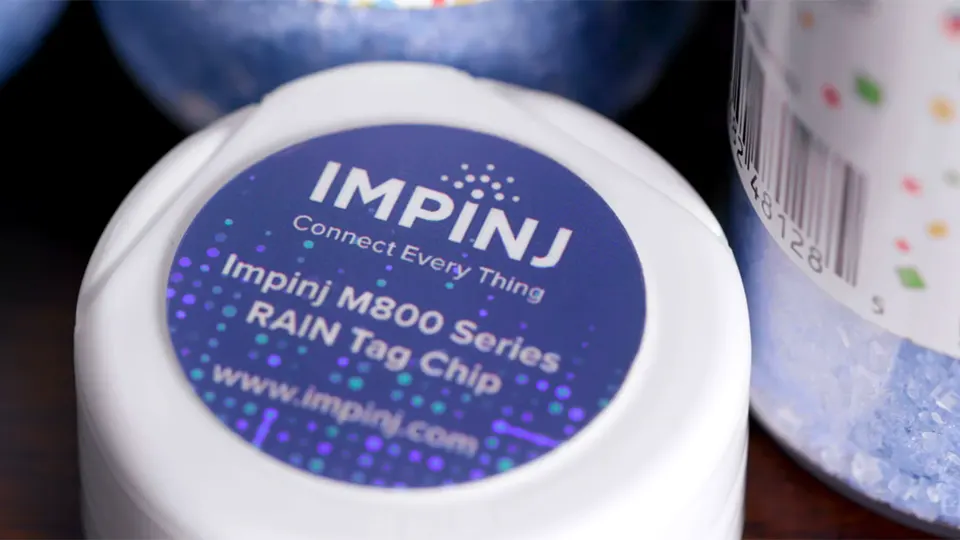
Impinj M800 is the newer generation within Impinj’s RAIN RFID endpoint portfolio. The M830 provides 128 bits of EPC memory, while the M850 provides 96 bits of EPC memory and 32 bits of user memory. Impinj specifies read sensitivity of up to -25.5 dBm with a dipole antenna. The platform is designed for applications where dense tag populations, compact tag designs and demanding reading conditions are common.
NXP UCODE covers a broader range of memory configurations. UCODE 9 provides 96 bits of EPC memory, while UCODE 9xe provides 128 bits. UCODE 9xm offers substantially more configurable memory for applications that need additional EPC or user-memory capacity.
Those specifications help narrow the options. They do not, on their own, determine how a finished label will perform on a particular product.
Where Impinj M800 fits well
The Impinj M800 family is particularly relevant to applications where large numbers of tags need to be identified quickly and consistently.
Retail inventory is one example. A store may have hundreds or thousands of tagged products within a reader’s field during an inventory count. The same tag may be read during receiving, replenishment, shelf checks, returns and stock transfers. In this environment, consistent identification across a dense group of products is more useful than simply chasing the longest possible read distance.
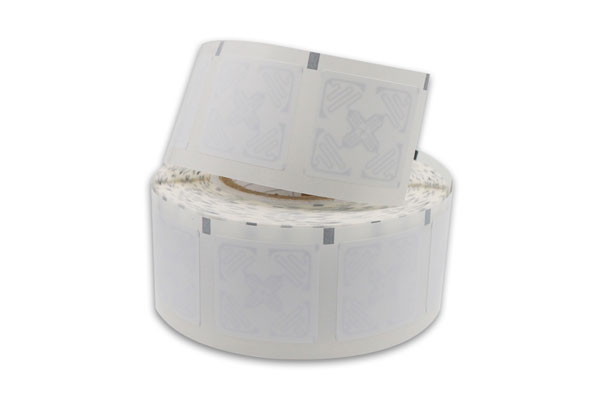
The DTB-C42M Label is a good example from DTB’s product range. It is listed for retail applications and uses the Impinj M700 Series, with a 46 × 22 mm tag size and a 42 × 18 mm antenna. DTB specifies a front read range of more than 3 m under its stated test conditions, with the distance varying according to reading direction.
That makes C42M particularly relevant when discussing apparel and retail inventory. The label remains compact enough for product identification while providing an antenna format designed for ordinary non-metal retail products.
For logistics and supply chain applications, the DTB-C40M Label provides another useful example. DTB lists it for retail, apparel, logistics and supply chain applications and specifies an Impinj M730 chip with a 44 × 18 mm tag size. The product page gives an approximate 8 m read range under its stated US-standard handheld test conditions.
C40M should not be described as an M830 or M850 tag unless the specific production configuration confirms that chip. DTB’s industry listing places the product in its Impinj M730/M830 range, while the individual product page currently identifies the IC as Impinj M730.
This distinction is useful when selecting RFID tags for a real project. A product family may support several chip configurations, while the exact chip installed in a production order still needs to be confirmed.
NXP UCODE works across very different tag formats
NXP UCODE is also used across retail, logistics and other item-level RFID applications, but its flexibility becomes particularly apparent when looking at different tag formats.
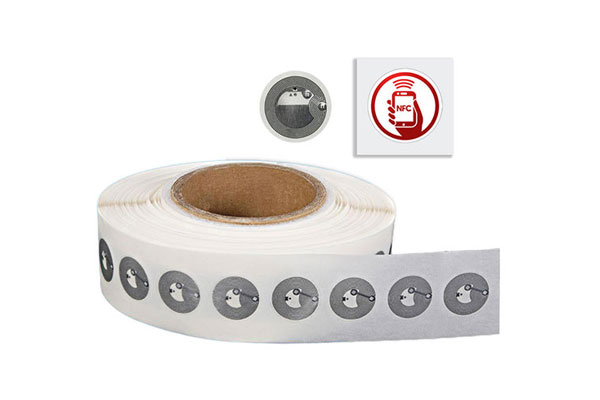
The DTB-C40U Label is designed for a compact general-purpose format. DTB lists an NXP UCODE 9xe chip, with a 43 × 21 mm tag size. The product is positioned for logistics, supply chain, apparel and asset-related applications.
For a logistics operation, this type of label can be applied to cartons, packages or individual products where a compact adhesive tag is preferred. The relatively small footprint also makes it easier to integrate into existing packaging without taking up much visible space.
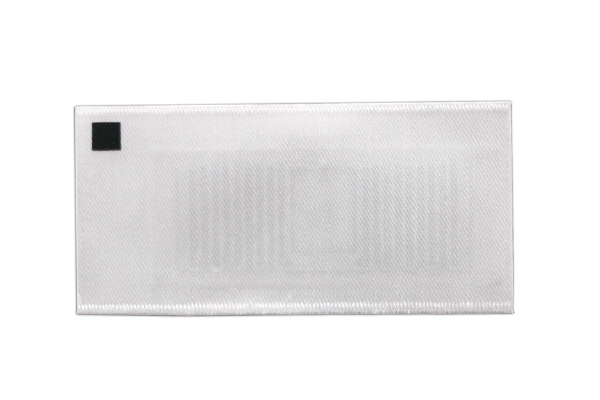
The DTB-L95U Label shows a very different application. It uses NXP UCODE 9 and measures 104 × 5.5 mm, with a 95 × 3 mm antenna. DTB specifically lists it for library management and specifies an approximate 5 m read range under its stated handheld test conditions.
The narrow shape is important here. A library tag has to fit inside a book and leave the printed material and normal handling unaffected. During circulation and inventory work, the same tag may be read repeatedly as books are checked in, returned, shelved and counted.
These two DTB products show why UCODE selection should be considered together with the physical tag. C40U and L95U both use the NXP UCODE family, yet their dimensions, antenna structures and target applications are quite different.
The antenna often changes the result
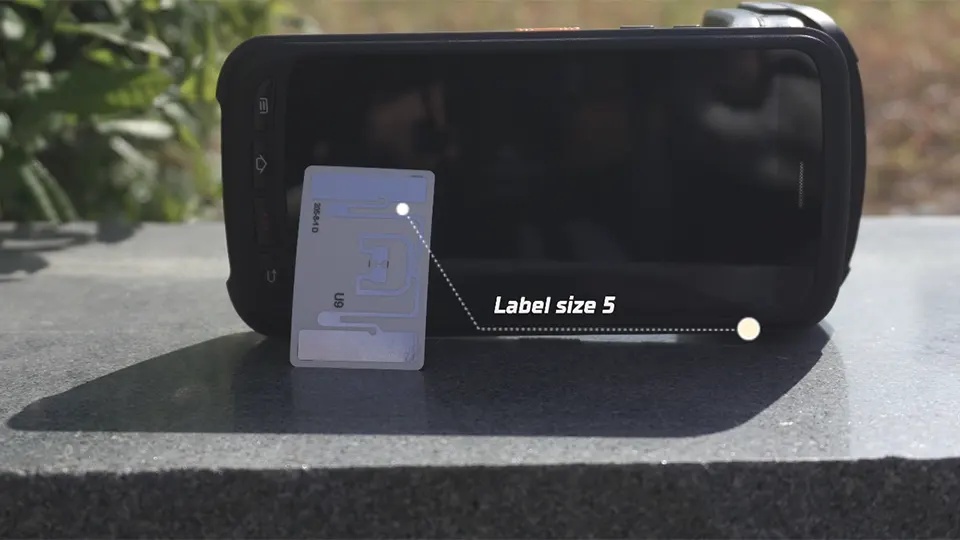
Chip specifications are easy to compare because they come in numbers. Antenna performance is harder to judge from a datasheet alone.
A smaller antenna can make a tag easier to hide inside a garment or package, but reducing antenna size also changes the electrical characteristics of the tag. The finished label needs to be tuned for the intended operating environment.
The product itself adds another variable. A label attached to cardboard is working in a different environment from one placed near metal hardware. Leather, liquids, dense packaging and other materials can also affect RF performance.
This is why a tag that performs well on a test sheet should still be tested on the actual product. The final installation position can change the result just as much as the chip.
A practical development process is straightforward:
- Define the product, attachment position and reading environment.
- Set the required tag dimensions and antenna area.
- Select the chip according to memory, sensitivity and application requirements.
- Test the complete label on the finished product with the intended reader.
- Repeat the test under realistic warehouse, retail or logistics conditions.
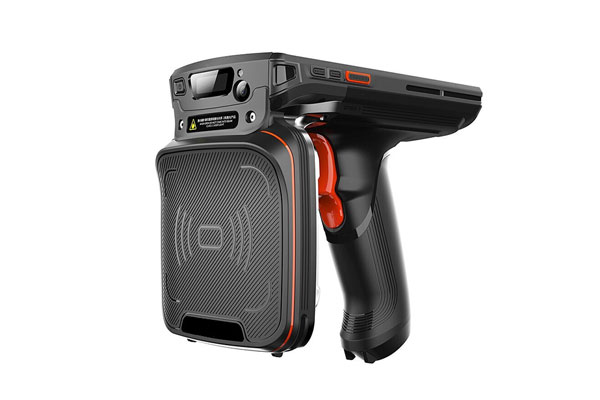
Reader settings matter as well. Transmit power, antenna placement, polarization, reader sensitivity and the distance between products all influence the number and consistency of successful reads.
This is also why there is no single “best” RFID label for every application. Different antenna sizes and constructions allow the same chip family to be adapted to different products.
Match the tag to the workflow
RFID specifications become much easier to evaluate when the entire product journey is mapped out.
Consider apparel. A tag may be encoded during production, read when cartons are packed, scanned at a distribution center, counted in a store and read again when an item is returned. The label has to remain usable through all of these stages.
Logistics has a different pattern. A carton may pass through receiving, storage, picking and shipping. At some points, one tag is being read; at others, dozens or hundreds of tags may be within the reader’s field.
Library management is different again. The tag remains attached to the same physical item for a long period, while the workflow revolves around circulation, shelving and periodic inventory.
The selection process can stay focused:
- Map every point where the product needs to be identified.
- Define the main use case, such as retail inventory, logistics tracking, asset management or library management.
- Set the required tag size, read distance and material conditions.
- Compare suitable chip and antenna configurations.
- Test the finished label before finalizing the production specification.
For a standard retail item, 96-bit EPC memory is often enough for a unique serialized identifier. A larger EPC or additional user memory becomes more useful when the encoding structure requires it.
That decision should also match the software and database architecture. Product information does not always need to be stored directly on the RFID tag. In many systems, the EPC simply identifies the item while the detailed product record remains in the backend system.
Choosing between M800 and UCODE
Impinj M800 and NXP UCODE both have a place in mainstream RAIN RFID deployments. The choice comes down to the finished tag, the product and the workflow around it.
For retail and apparel, the DTB-C42M provides a useful example of a compact label built around the Impinj platform. For logistics and supply chain work, DTB-C40M offers another form factor from the same general product range.
On the NXP side, DTB-C40U is aimed at compact logistics, apparel and asset applications, while DTB-L95U takes the same UCODE family into the very different environment of library management.
The comparison should therefore be made at the finished-label level rather than from chip specifications alone. Memory capacity and sensitivity matter, but so do antenna dimensions, label construction, attachment position and the reader used in the deployment.
For an RFID project, the most useful specification is often the one describing the complete label and its tested performance on the actual product.
The chip provides the RFID platform. The tag design determines how well that platform works once it leaves the datasheet and enters the warehouse, store, carton or book.

